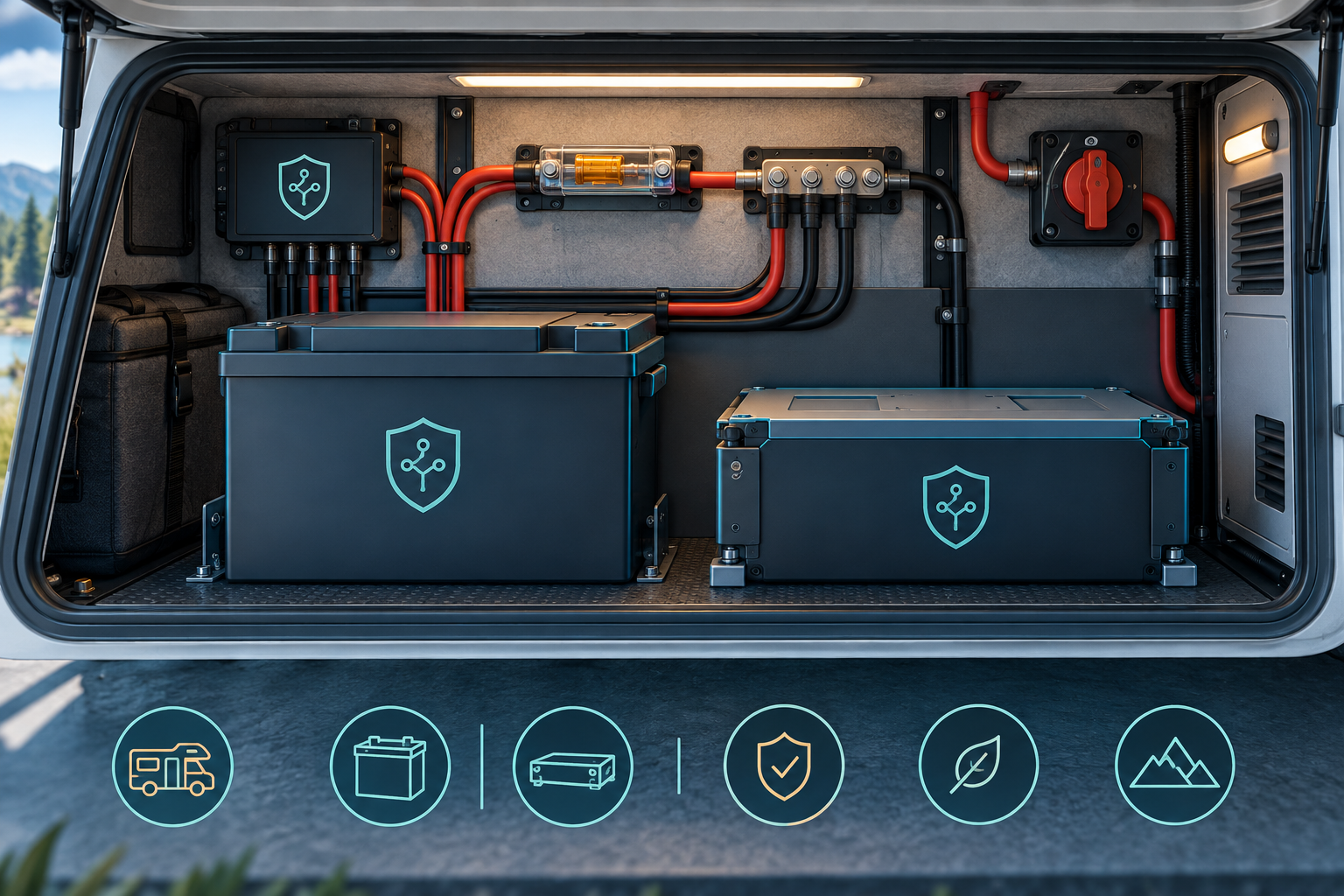
The best lithium battery for an RV is the one that fits the complete electrical system. Capacity matters, but so do continuous current, charging compatibility, low-temperature behavior, mechanical fit, support and documented protection features.
Start with the system requirement
Before comparing products, calculate daily watt-hours and peak simultaneous current. A battery that comfortably powers lighting and a refrigerator may not support a large inverter, induction cooktop or air conditioner. Use the battery bank sizing guide to establish the requirement first.
Eight specifications worth comparing
| Specification | Why it matters |
|---|---|
| Nominal energy | Voltage × amp-hours gives a comparable watt-hour figure. |
| Continuous discharge current | Must support the expected sustained load. |
| Surge current and duration | Relevant to motors, compressors and inverter surge. |
| Charge current limits | Must match solar, alternator and shore charging. |
| Low-temperature charge protection | Prevents charging outside the battery’s allowed temperature range. |
| Communication or monitoring | May improve state-of-charge visibility and system integration. |
| Dimensions and terminal layout | Determine whether the installation is mechanically practical. |
| Warranty terms | Read exclusions, transfer rules and service process—not only years. |
BMS current must match the inverter
A battery management system protects the cells, but its current rating is also a system limit. Estimate inverter DC current by dividing AC output power by battery voltage and inverter efficiency. Then check both continuous and surge conditions. In a multi-battery bank, do not simply multiply ratings unless the manufacturer permits the configuration and the wiring shares current correctly.
Charging compatibility is not optional
Confirm acceptable charge voltage, current and temperature with the battery documentation. An alternator-based RV often needs a properly sized DC-to-DC charger to manage current and charging behavior. Solar controllers and shore chargers need a suitable profile. “Lithium mode” is useful only when its actual voltage and timing match the battery requirements.
Cold-weather use
Lithium iron phosphate batteries can usually discharge below the temperature at which charging becomes restricted, but exact limits vary. A battery may use low-temperature charge cutoff, an internal heater, both or neither. Decide whether the RV will be stored or charged in freezing conditions and verify how the protection is implemented.
Installation and safety review
- Secure the battery against vehicle movement.
- Protect the positive conductor close to the energy source.
- Use a disconnect rated for the system current.
- Keep terminals guarded from accidental contact.
- Use conductor sizes and lugs appropriate to current and environment.
- Provide ventilation or spacing required by installed equipment.
Use our 12V wire size calculator only as an initial voltage-drop check; ampacity and installation rules still govern the final choice.
A simple buying decision
Shortlist only batteries that meet the required current, energy, temperature and mechanical constraints. Then compare documentation quality, warranty service and price per usable watt-hour. A cheaper battery that forces an inverter downgrade or cannot be charged safely by the existing system is not the lower-cost choice.
Planning note: Treat these calculations as a design starting point. Confirm final equipment, conductor and protection choices against current manufacturer instructions and applicable codes.
Frequently asked questions
Is LiFePO4 worth it for an RV?
It can offer high usable energy, low weight and long service life, but value depends on charging compatibility, climate, current needs and installation cost.
What size lithium battery do I need for an RV?
Calculate daily watt-hours, autonomy and system losses, then verify that the battery BMS supports the maximum simultaneous current.
Can I replace an RV lead-acid battery with lithium?
Sometimes, but it should not be assumed to be a drop-in change. Verify alternator charging, shore charger, solar controller, temperature protection, wiring and battery mounting.