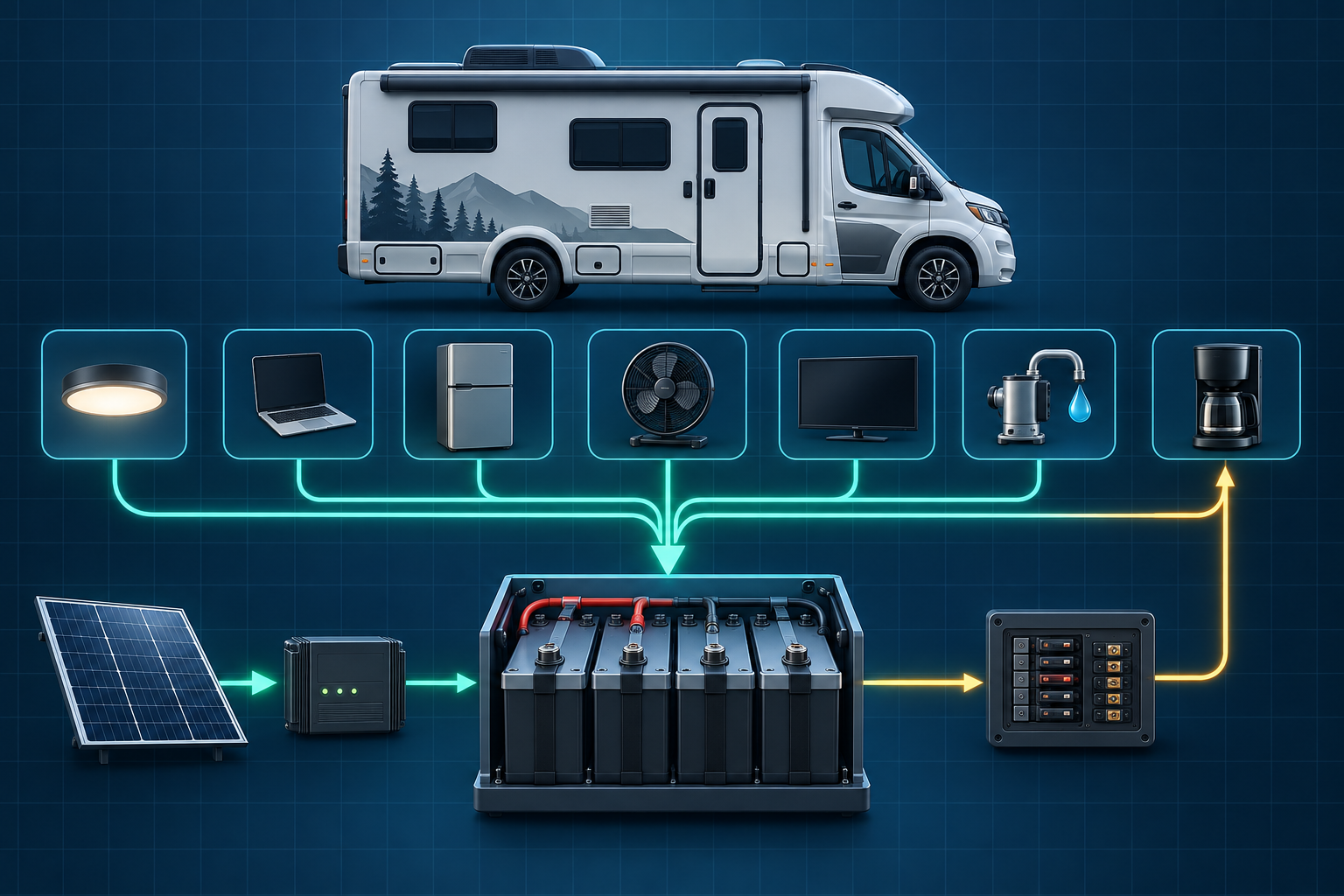
The reliable way to size an RV battery bank is to start with energy use—not a battery label. Add your daily loads in watt-hours, choose a realistic reserve period, then account for usable depth of discharge and system losses.
The short answer
Required nominal battery energy = daily watt-hours × days of autonomy ÷ usable fraction ÷ system efficiency. Convert watt-hours to amp-hours by dividing by nominal system voltage.
For example, a 1,200 Wh daily load, one day of autonomy, 90% usable depth and 90% overall efficiency needs about 1,646 Wh nominal. At 12.8 V, that is roughly 129 Ah. A practical design would then be checked against available battery sizes, peak current, charging time and reserve needs.
Step 1: build a daily load audit
List every DC and AC load you expect to use. For each one, multiply watts by hours per day. If a device is rated in amps, multiply amps by operating voltage to estimate watts. Refrigerators, pumps and heaters cycle, so use realistic duty time rather than assuming they run continuously.
| Load | Power | Daily use | Energy |
|---|---|---|---|
| 12V refrigerator | 45 W average while running | 10 h equivalent | 450 Wh |
| Lighting | 25 W | 4 h | 100 Wh |
| Laptop charging | 65 W | 3 h | 195 Wh |
| Water pump | 60 W | 0.3 h | 18 Wh |
Add inverter standby consumption and any equipment that stays on overnight. A small continuous load can consume more energy over 24 hours than a large appliance used briefly.
Step 2: choose autonomy and usable depth
Autonomy is how long you want the battery to support the RV without meaningful charging. One day may suit frequent driving or reliable shore power; two or more days may suit boondocking. Usable depth depends on chemistry, temperature, battery management limits and the service-life target.
Do not treat the advertised amp-hour rating as fully usable energy. Keep the usable-depth assumption editable and conservative. Our battery capacity calculator exposes each assumption.
Step 3: verify peak power, not just energy
Energy capacity answers “how long?” but not “can it run this load?” Check the maximum simultaneous DC current. A 2,000 W inverter on a 12 V bank can draw well over 150 A after losses. The battery management system, parallel interconnects, disconnect, fuse, busbars and cable must all support the design current.
Use the inverter manufacturer’s installation guidance for cable and fuse selection. If several batteries are paralleled, design equal-current paths so one battery is not forced to carry most of the load.
Step 4: make sure charging can replace the energy
A large battery bank is not useful if the available solar, alternator charger or shore charger cannot restore it within the time you actually have. Compare daily energy use with realistic daily harvest, not panel nameplate watts. Start with the RV solar calculator, then adjust for season, shading and location.
A practical sizing checklist
- Measure or estimate daily watt-hours.
- Add always-on and inverter standby loads.
- Select a realistic autonomy target.
- Apply usable-depth and efficiency assumptions.
- Convert required watt-hours to amp-hours at system voltage.
- Check peak current and BMS limits.
- Verify charging capacity and recovery time.
- Confirm conductors and over-current protection.
For a runtime check after choosing a candidate battery, use the battery runtime calculator.
Planning note: Treat these calculations as a design starting point. Confirm final equipment, conductor and protection choices against current manufacturer instructions and applicable codes.
Frequently asked questions
Is 100Ah enough for an RV?
It can be enough for light loads and regular charging, but the answer depends on daily watt-hours, usable depth, inverter use and desired autonomy.
Should I size an RV battery in amp-hours or watt-hours?
Use watt-hours to compare total energy, especially when comparing different system voltages. Convert to amp-hours only after choosing the nominal voltage.
How much reserve capacity should I add?
Add reserve for uncertainty, cold weather and battery ageing only after building a realistic load audit. More capacity also requires more space, cost and charging capability.