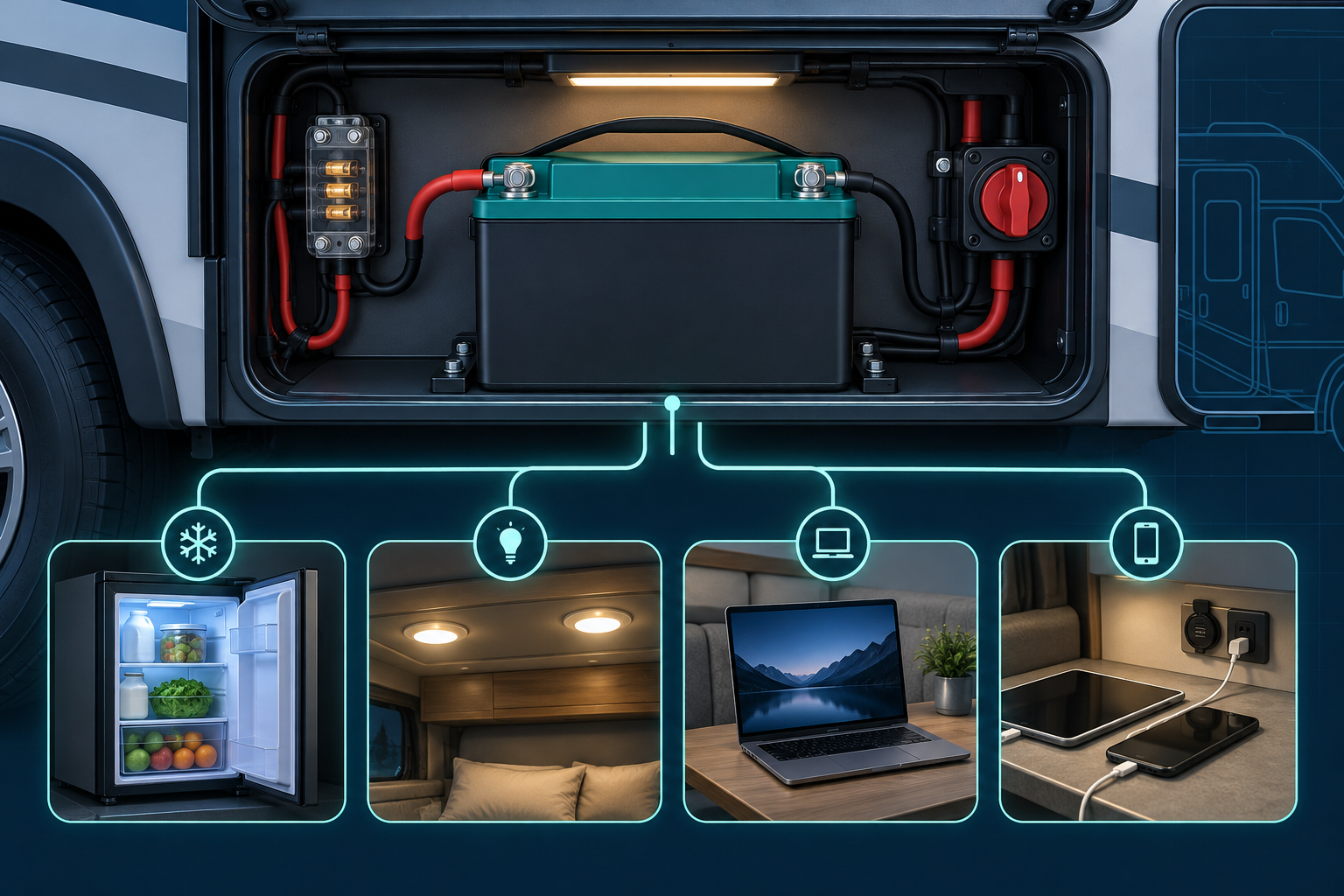
A 100Ah LiFePO4 battery is a practical building block for light RV loads, compact installations and modular banks. Compare products by usable energy and current capability—not amp-hours alone.
What 100Ah means
At a nominal 12.8 V, 100 Ah equals about 1,280 Wh of stored energy. With 90% usable depth and 90% conversion efficiency, a planning estimate is about 1,037 Wh delivered to the load. Exact limits come from the battery documentation.
| Average load | Planning runtime | Example use |
|---|---|---|
| 50 W | About 21 hours | Efficient refrigerator average |
| 100 W | About 10 hours | Mixed light loads |
| 500 W | About 2 hours | Short inverter use |
Run your own numbers with the runtime calculator.
Who a 100Ah battery suits
- Weekend camping with regular driving or shore charging.
- Lighting, water pump, electronics and an efficient refrigerator.
- Small vans with limited battery space.
- Modular systems that may add a matched second battery later.
It may be too small for long autonomy, electric cooking, air conditioning or high continuous inverter use.
Seven specifications to compare
- Continuous discharge current.
- Surge current and permitted duration.
- Maximum and recommended charge current.
- Low-temperature charge cutoff or heating.
- Physical size, weight and terminal orientation.
- Permitted series and parallel configurations.
- Warranty exclusions and service process.
BMS and inverter fit
A 100 A BMS does not mean every 100 Ah battery can run every inverter labeled near 1,000 W. Account for inverter loss, surge, temperature and the manufacturer’s continuous-duration definition. Verify the inverter manual, battery BMS limit, fuse, disconnect and cable as a single high-current path.
One 100Ah battery or two in parallel?
Two compatible 100Ah batteries can provide roughly twice the energy and may increase available current. The manufacturer must permit paralleling, and the wiring should provide balanced resistance to each battery. Starting with one larger battery can simplify interconnections, while two smaller units may improve packaging and serviceability.
Buying checklist
- Calculate daily Wh before shopping.
- Confirm continuous and surge current.
- Check every charge source.
- Verify cold-weather behavior.
- Measure the battery compartment and cable route.
- Read warranty terms, not only the headline duration.
For wider system context, read the RV lithium battery guide.
Planning note: Treat these calculations as a design starting point. Confirm final equipment, conductor and protection choices against current manufacturer instructions and applicable codes.
Frequently asked questions
How long will a 100Ah lithium battery run an RV refrigerator?
Use the refrigerator’s measured daily watt-hours. A 100Ah battery may run an efficient refrigerator overnight or longer, but ambient temperature and duty cycle matter.
Can a 100Ah lithium battery run a microwave?
Possibly for short periods if the battery BMS, inverter, cables and protection support the high current. Energy capacity alone does not prove compatibility.
Can I add another 100Ah battery later?
Only if the manufacturer permits it and the batteries can be brought to compatible state of charge, age and configuration with balanced wiring.