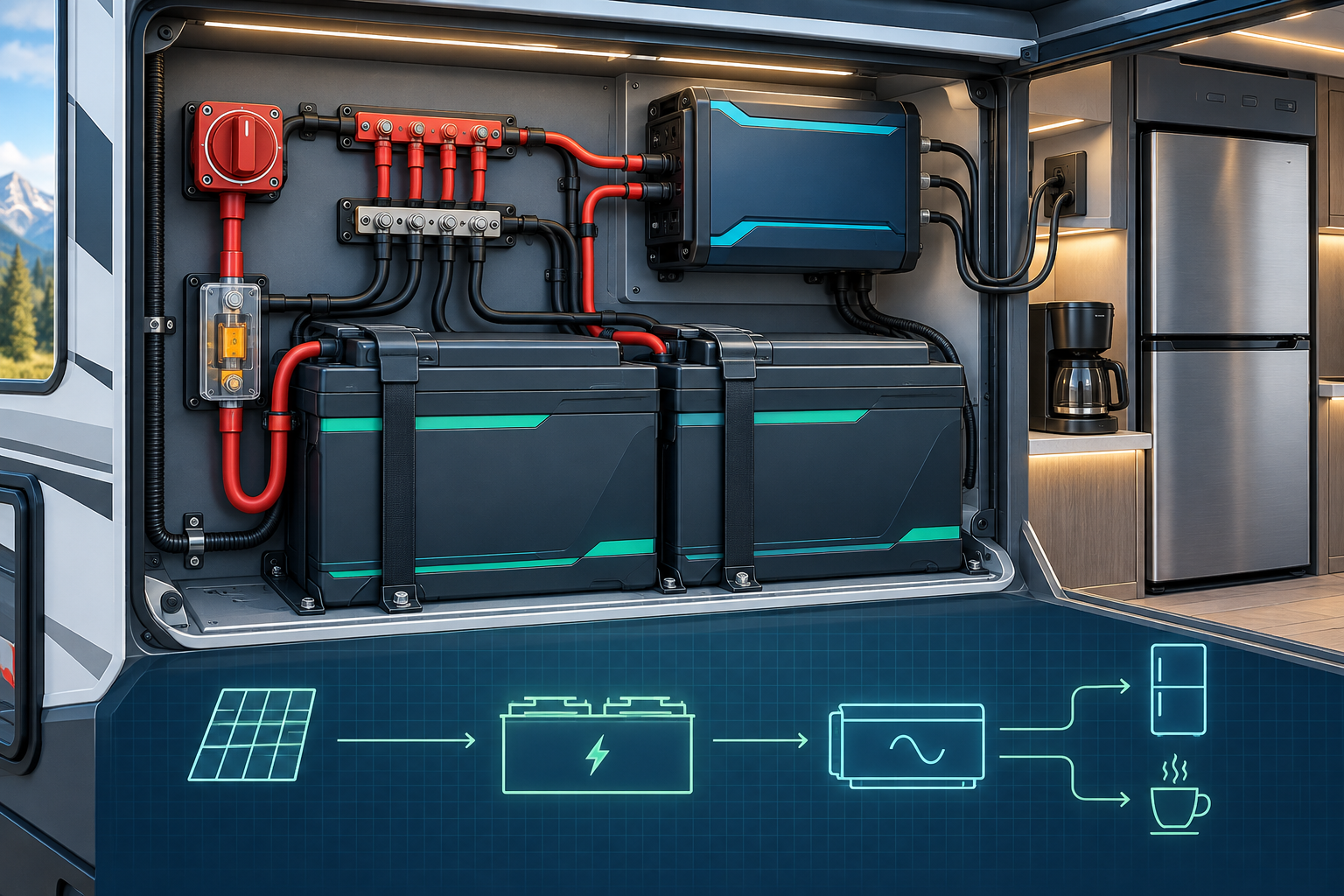
A nominal 12.8 V, 200Ah lithium battery stores about 2.56 kWh. That capacity can support broader RV use than a 100Ah battery, but only when the BMS, inverter, charging equipment and high-current wiring are designed together.
Usable energy and runtime
Using 90% usable depth and 90% system efficiency gives a planning value of about 2.07 kWh delivered to loads.
| Average load | Planning runtime | Interpretation |
|---|---|---|
| 75 W | About 27.6 hours | Light mixed DC loads |
| 200 W | About 10.4 hours | Refrigeration plus electronics |
| 1,000 W | About 2.1 hours | Heavy inverter load |
Actual runtime changes with cycling, standby draw, temperature and current limits.
When 200Ah is a good fit
- Multi-day light-load camping with solar support.
- Regular inverter use for kitchen or office equipment.
- A system designed around roughly 2 kWh of usable daily energy.
- Owners who can recharge the bank within their normal travel pattern.
Start with the capacity calculator rather than choosing 200Ah because it is a common product size.
Current capability still matters
A large amp-hour rating does not guarantee a high discharge rating. Some 200Ah batteries use a BMS intended for moderate loads; others support larger inverters. Estimate maximum DC current and compare continuous and surge limits. The battery, fuse, disconnect, busbars and conductors must all be suitable.
Charging-time reality
A 200Ah bank can take roughly twice as long to recharge as a 100Ah bank at the same charge current. Solar output varies with season and shading, while alternator and shore chargers have current and thermal limits.
| Net charge current | Idealized time for 100Ah returned | Planning note |
|---|---|---|
| 20 A | 5 hours | Allow more time for taper and losses |
| 40 A | 2.5 hours | Verify battery and charger limits |
| 60 A | 1.7 hours | Check wiring and thermal conditions |
One 200Ah battery versus two 100Ah units
One battery reduces external interconnects and can simplify monitoring. Two smaller units may fit the compartment better and allow service of one unit, but they require balanced wiring and compatible BMS behavior. Compare the total system, not only purchase price.
Installation checklist
- Confirm dimensions, weight and restraint points.
- Check terminal layout and protective covers.
- Verify BMS current against the inverter.
- Size charging equipment and recovery time.
- Check cable ampacity and voltage drop.
- Coordinate source fuse and disconnect ratings.
Compare the smaller option in the 100Ah lithium battery guide.
Planning note: Treat these calculations as a design starting point. Confirm final equipment, conductor and protection choices against current manufacturer instructions and applicable codes.
Frequently asked questions
How long will a 200Ah lithium battery last?
At 12.8 V with 90% usable depth and 90% efficiency, the planning value is about 2.07 kWh. Divide that by average load watts for estimated hours.
Can a 200Ah battery run a 2,000W inverter?
Only if the battery BMS and every high-current component support the resulting continuous and surge current. Check the battery and inverter manuals.
How much solar is needed for a 200Ah battery?
Solar should be sized from daily energy use and available peak-sun hours, not battery capacity alone. A larger bank may store more energy without increasing daily consumption.