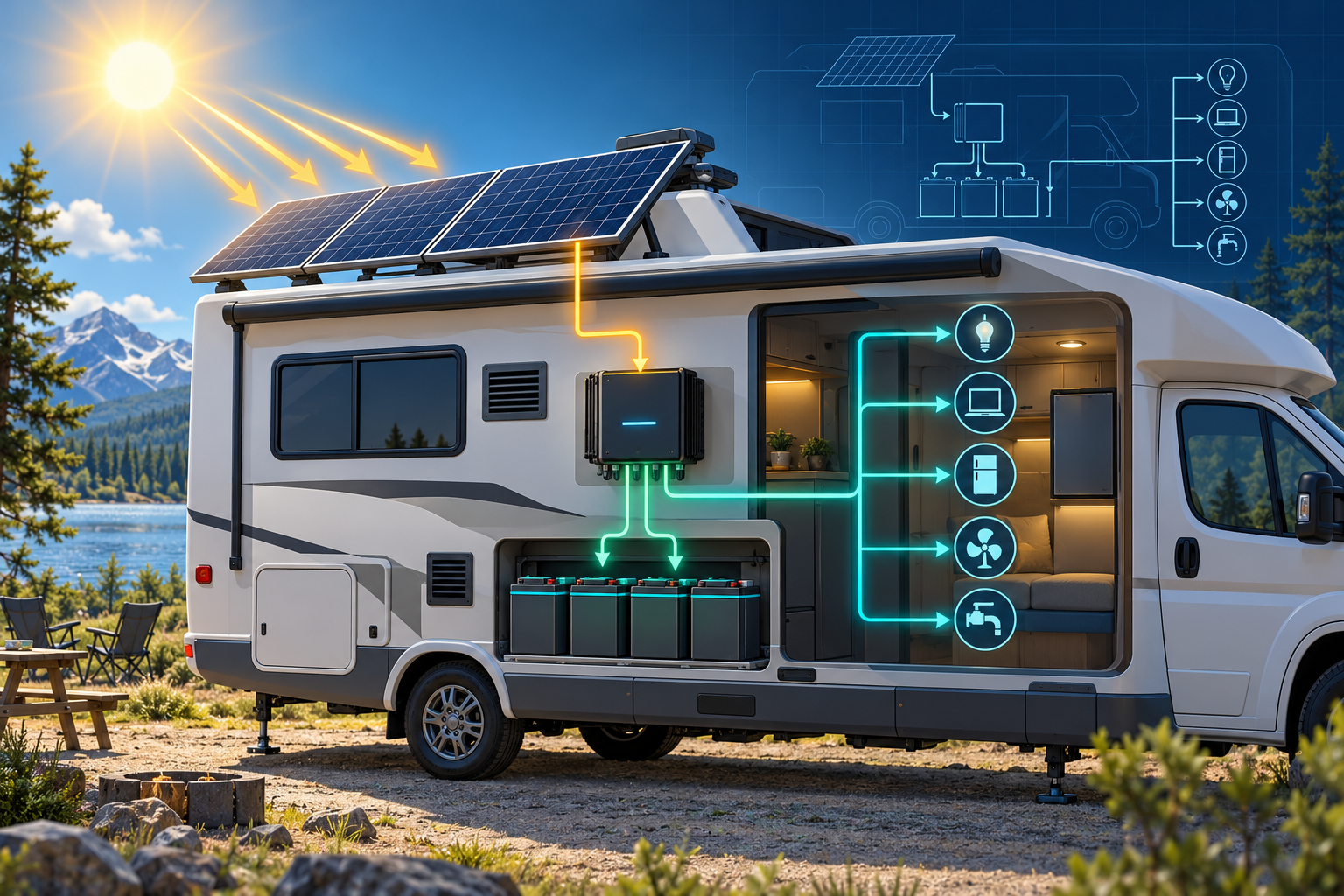
Size RV solar from daily energy use, not from battery amp-hours or roof area alone. Divide daily watt-hours by realistic peak-sun hours and overall solar-system efficiency, then check seasonal conditions and physical constraints.
The basic formula
Solar array watts = daily energy use in Wh ÷ peak-sun hours ÷ system efficiency.
If an RV uses 1,200 Wh per day, receives 4 peak-sun hours and the overall system is estimated at 75% efficiency, the starting array size is 400 W. Use the RV solar calculator to change those assumptions.
Example solar sizes
| Daily use | Peak-sun hours | Efficiency | Starting array |
|---|---|---|---|
| 600 Wh | 4 | 75% | 200 W |
| 1,200 Wh | 4 | 75% | 400 W |
| 2,000 Wh | 4 | 75% | About 670 W |
| 1,200 Wh | 2.5 | 70% | About 690 W |
The last row shows why winter, clouds and location matter. The same loads can require a much larger array when solar conditions are weaker.
Build the daily energy budget
Add appliance watts multiplied by hours of use. For cycling loads such as refrigerators, use measured daily watt-hours when possible. Include inverter standby, charging electronics and always-on controls. The battery capacity calculator helps translate the same energy budget into storage.
Peak-sun hours are not daylight hours
Peak-sun hours combine changing solar intensity into equivalent hours at full rated irradiance. They vary by location, season, panel angle, weather and shading. A summer estimate from a sunny region can significantly overstate winter harvest elsewhere.
Roof and controller constraints
- Measure usable roof space around vents, antennas and service clearances.
- Check panel voltage at the coldest expected temperature.
- Keep array voltage and current within controller limits.
- Choose conductor sizes for current, length and environment.
- Provide appropriate disconnects and over-current protection where required.
Panel arrangement must satisfy the controller manufacturer’s input limits, not just the total watt figure.
Battery capacity and solar are related—but different
The battery stores energy; the array produces energy. A large battery can provide more autonomy, but it does not automatically require more solar if daily consumption stays the same. Conversely, a small battery may be unable to store a large midday harvest. Design both around the load profile and travel pattern.
Plan for alternatives
Solar is variable. Many RVs combine it with alternator charging, shore power or a generator. Decide how many low-sun days the battery should cover and how quickly another source can recover the bank. A resilient design does not assume every day will match the calculator.
For the full system sequence, see RV Power Systems.
Planning note: Treat these calculations as a design starting point. Confirm final equipment, conductor and protection choices against current manufacturer instructions and applicable codes.
Frequently asked questions
Is 200 watts of solar enough for an RV?
It can cover light loads in favorable sun. Calculate daily watt-hours and local peak-sun hours; 200 W at four peak-sun hours and 75% efficiency yields roughly 600 Wh per day.
How much solar is needed to charge a 100Ah battery?
The answer depends on how many watt-hours must be replaced and the available sun. Battery capacity alone does not state daily energy use.
Can RV solar run air conditioning?
Air conditioning usually requires high energy and inverter power. A solar-assisted system may help, but roof area, battery capacity, charging conditions and surge current often make continuous off-grid operation challenging.