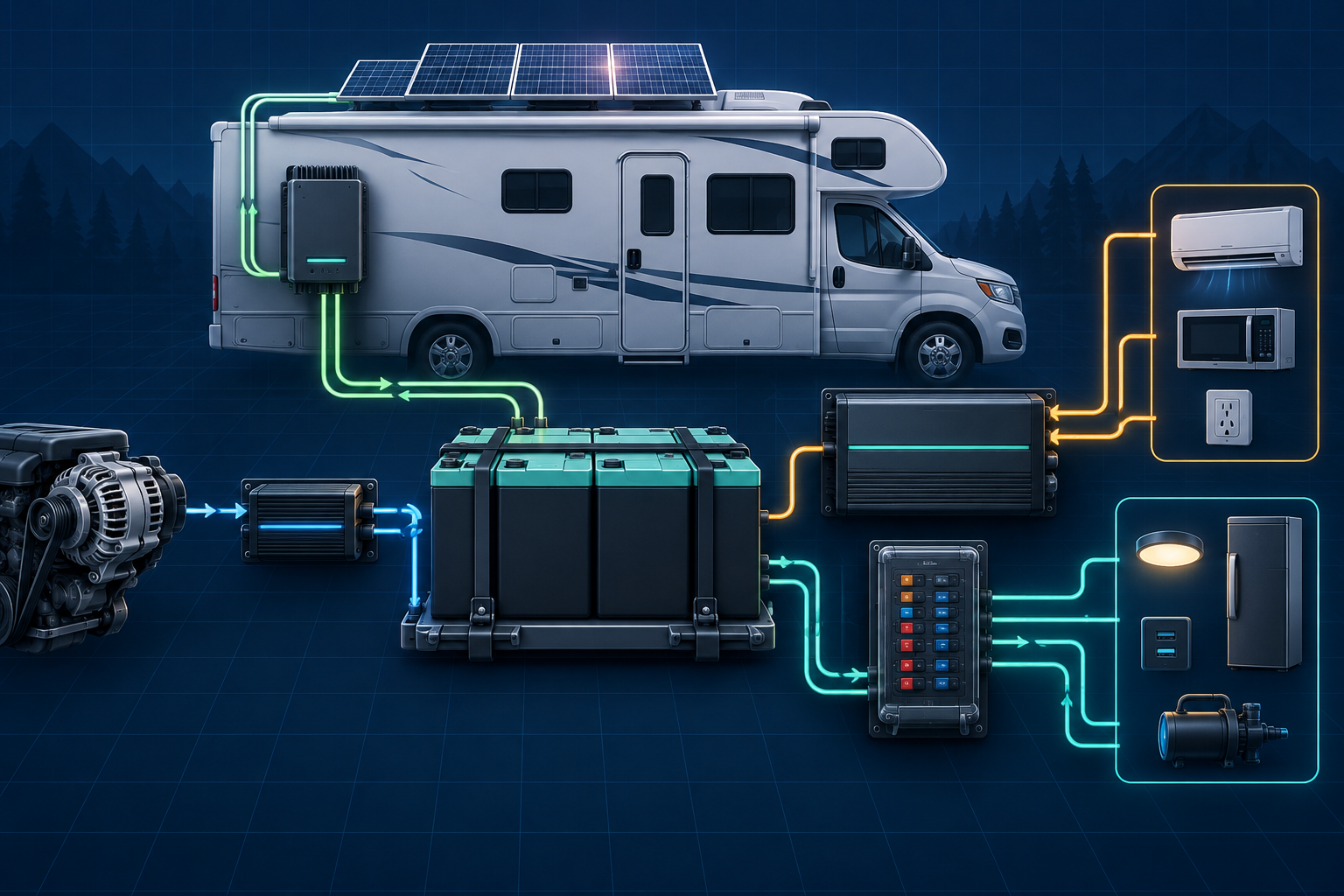
An RV lithium battery is not a standalone upgrade. It is one part of a system that includes loads, charging sources, an inverter, conductors, protection and temperature limits. The right battery is the one that fits every link in that chain.
Start with energy and current
Use watt-hours to size stored energy and amps to check current capability. A nominal 12.8 V, 100 Ah battery stores about 1,280 Wh, while a 200 Ah battery stores about 2,560 Wh. Usable energy is lower after the manufacturer’s depth-of-discharge limit and system losses.
| Design question | Value to calculate | What it controls |
|---|---|---|
| How long should loads run? | Daily Wh and autonomy | Battery capacity |
| What runs at the same time? | Peak and continuous amps | BMS, inverter and cable ratings |
| How quickly must energy return? | Charge amps and hours available | Solar, alternator and shore charging |
Build the load estimate with the battery capacity calculator.
LiFePO4 versus lead-acid in an RV
LiFePO4 batteries generally provide a larger usable fraction of their nameplate capacity and maintain voltage well under load. They are also lighter for comparable usable energy. The tradeoff is that charging equipment, low-temperature behavior and battery-management limits require more attention. A lead-acid system may remain practical for occasional use, modest loads and an existing compatible charger.
Understand the battery management system
The BMS protects cells from conditions such as excessive voltage, low voltage, over-current and disallowed temperature. Its continuous and surge current limits must exceed the planned load. A large inverter can exceed a small battery’s BMS rating even when the battery contains enough energy for a short run.
Do not use a BMS trip as normal circuit protection. The system still needs appropriate fusing, disconnects and conductor protection.
Check every charging source
- Shore charger: verify voltage profile, current and timing.
- Solar controller: program limits to match the battery documentation.
- Alternator: use a suitable charging strategy that manages current and protects the vehicle system.
- Generator: its AC output still reaches the battery through a charger with its own limits.
Adding a larger battery without enough charging capacity can leave the bank chronically undercharged during real travel.
Cold-weather charging
Many LiFePO4 cells must not be charged below their permitted temperature. Some batteries provide charge cutoff, internal heating or both. Confirm how the feature works, what powers the heater and whether the installation location can reach freezing temperatures.
Installation sequence
- Audit loads and choose system voltage.
- Size energy capacity and continuous current.
- Confirm all charging sources.
- Design short, balanced high-current paths.
- Select conductors by ampacity and voltage drop.
- Coordinate fuses, disconnects and component ratings.
- Secure batteries and guard terminals.
- Commission the system under measured load.
Use the 12V wire size calculator for an initial voltage-drop check and the methodology page for our evidence policy.
Choosing a capacity class
A 100 Ah battery can suit light daily loads and frequent charging. A 200 Ah class bank provides more autonomy and can support broader use when the BMS and wiring are matched. Larger banks make sense only when space, charging and system current have been designed for them. Continue with the 100Ah guide or 200Ah guide.
Planning note: Treat these calculations as a design starting point. Confirm final equipment, conductor and protection choices against current manufacturer instructions and applicable codes.
Frequently asked questions
Can I drop a lithium battery into an existing RV?
Sometimes, but verify the converter, alternator charging, solar controller, temperature protection, wiring, mounting and over-current protection first.
How many amp-hours does an RV need?
It depends on measured daily watt-hours, desired autonomy, usable depth, losses and charging frequency. Size in watt-hours first, then convert to amp-hours at system voltage.
Does an RV lithium battery need ventilation?
LiFePO4 batteries do not vent during normal operation like flooded lead-acid batteries, but the complete installation must still follow manufacturer requirements for temperature, spacing and surrounding equipment.